
Rests
- Tom Glasson

- Apr 4
- 2 min read
Updated: May 17
Rests are used to show moments of silence in music, where an instrument is not playing a note. This may be a large gap, or a small rest within a melody to create an interesting rhythm within a part.
The same way that there are different note shapes for different time values, there are also different rest shapes for different length of notes. These rests have a time value equivalent to note values.
Here they are;
Rest Values:

Rests:

The whole note rest is the same value as a whole note, this is 4 beats. In 4/4 this rest would be used to show an empty bar. This rest is beneath the 4th line.

The half note rest covers two beats. This rest is above the middle line.
It can be hard remember which way around these go, try to remember the whole note rest is the top one and the half note rest is lower down on the stave.

The quarter note rest is one beat.

The 8th note rest is half as long.

The 16th note rest. There would be 16 of these in a bar of 4/4
Just like there are shorter notes than this, there are rests for shorter notes too. The 32nd note rest adds another head to the 16th note rest, so there would be three of them. This is a very short rest, we will look at this more in the Grade 5 course.
Combining Rests:
Rests can be combined together to create longer periods of rests, in a similar manner to notes. For example, this is three beats of rest in a 4/4 bar. Unlike notes, there is no need to tie rests as they are silent and are not played
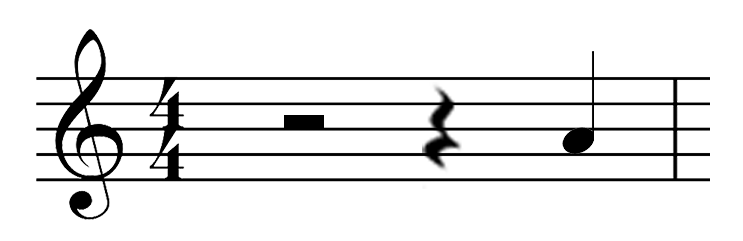
.
Rests can be dotted, the same way as notes. So this dotted rest is one and a half beats of rest.

Bar rests are often combined to make the music cleaner. For example below, this is how to show 8 bars of rests - the number above can be any number to show how many bars, in this case it is 8 bars. Instrument parts will often have this within a piece of music.

Next Steps:
Grouping rests along with the notes within a bar needs to be done carefully. This follows similar rules for grouping notes. For more on this topic, start here with Grouping Notes at Grade 1.
A Free Gift for you...
Download the Grade 1 Music Theory Workbook - An Introduction to Music Theory for free. The workbook is a written course which teaches you the entire content of Grade 1 music theory from start to finish, it is the full written version of our video course. It contains activities, with answers, to test your knowledge and give you chance to practice what you are learning.
There are 19 sections, covering every topic as well as reference sheets and materials which will come in handy as you study.
Click here to check it out.


Comments